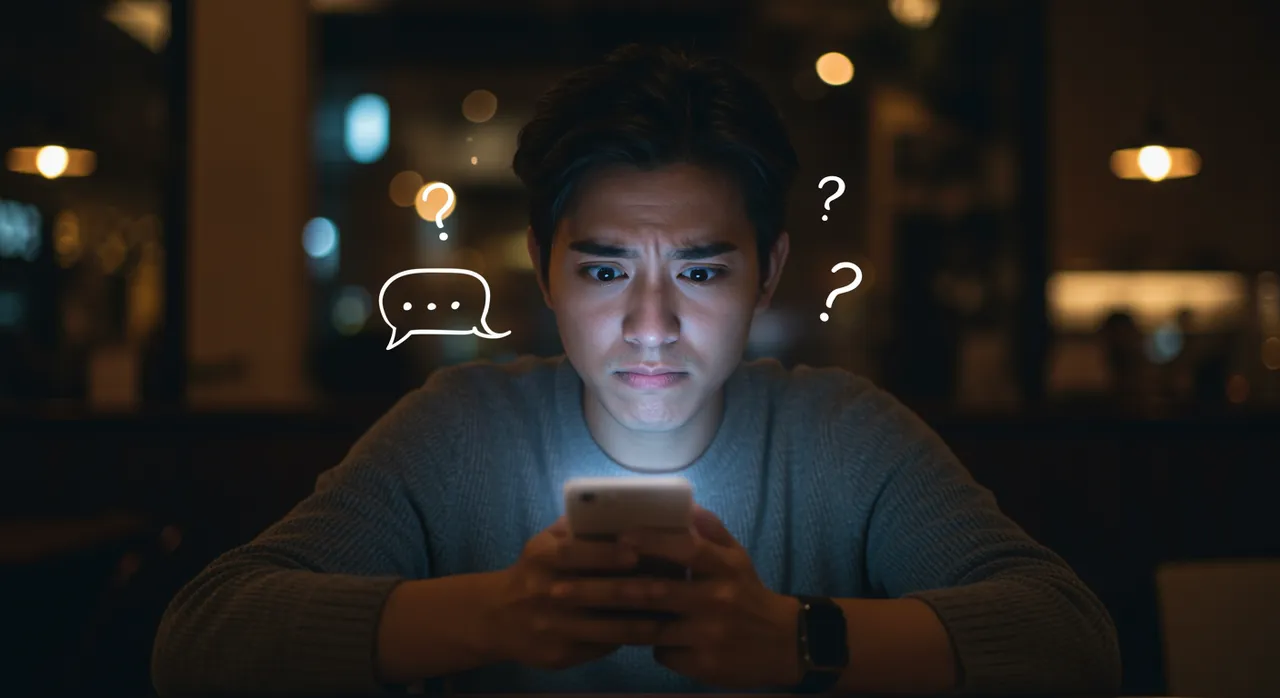
You match with someone. The conversation is effortless: clever, warm, almost too easy. Then you meet, and the spark on the screen has vanished. The person across the table can barely string the same sentences together. You might have just been chatfished.
of US singles now use AI to help them date: a 333% jump in a single year (Match / Kinsey Institute). And in a 2025 Norton survey, roughly 6 in 10 dating-app users said they believe they've already chatted with AI-written messages.
Chatfishing vs catfishing
Catfishing fakes an identity: a fake name, fake photos, a fake person. Chatfishing fakes a personality. The photos and name may be real, but the charm isn't: messages are written or heavily "improved" by AI tools like ChatGPT or "wingman" apps that generate replies from screenshots. You're not falling for them. You're falling for an algorithm doing an impression of them.
Why people do it
Mostly fear. Dating is anxiety-inducing (the majority of young daters cite fear of rejection), and AI promises a shortcut past the vulnerability of saying something in your own, imperfect voice. It feels like leveling the playing field. The problem is what it costs.
Authenticity over convenience. The goal of dating isn't to send the perfect message; it's to be genuinely known.
The hidden cost
Chatfishing creates a gap that reality always closes. Three problems follow:
- The reveal is brutal. The version of you that AI built can't show up to the date. The bigger the gap between the texts and the person, the harder the letdown.
- It erases the actual signal. Early conversation is how you sense whether you click. Outsource it and you've deleted the data you were trying to gather.
- It erodes trust everywhere. As more messages are machine-made, everyone starts second-guessing whether anything is real, poisoning the well for genuine people.
How to tell if you're being chatfished
- Messages that are a little too polished: long, structured, suspiciously well-edited for casual chat.
- Replies that are profound but generic, like they've read every self-help book and have no specific memory of your conversation.
- Evasion on specifics. Personal, off-script follow-up questions get vague or delayed answers.
- A tone shift in person. The clearest tell of all: the texting voice and the real voice don't match.
Should you use AI to date?
This isn't a sermon against technology; it's a question of how. There's a clear line:
- Fair game: using AI to practise, to calm nerves, to get honest feedback on a pattern, or to understand why a conversation went sideways.
- Not fair game: using AI to impersonate you, so someone bonds with words you didn't write and a person who doesn't exist.
Use AI to become a better communicator, not to replace yourself in the conversation.
AI as a coach, not a crutch
This is exactly the line Only the One is built around. We're not anti-AI; our Love Coach is AI. But it works on your side of the table: it helps you build confidence, see your patterns, and say true things in your own voice. It will never write a message to deceive a match or pretend to be you. That's the difference between AI that helps you connect and AI that gets in the way of it.
AI that coaches you to be yourself, not to fake it.
Meet the Love CoachSources
- Match & the Kinsey Institute, "Singles in America," AI usage among singles, reported via TODAY.
- Norton, 2025 survey on AI-written dating conversations, via Scientific American.
- CBC News, "How AI is infiltrating the dating world," cbc.ca.